How to Choose the Best Water Damage Restoration Company in Florida
Your home is wet, the clock is running, and ten companies all claim to be the fastest. This 8-point checklist separates real restoration companies from truck-and-a-fan operations, plus the red flags that should end the call.
The best water damage restoration company in Florida answers live 24/7, arrives fast, measures and documents moisture from the first hour, works to IICRC S500 standards, prices each phase in writing, and knows Florida insurance law. If a company cannot explain its drying targets or pressures you to sign before inspecting, keep calling.
1. Do they answer live, 24/7?
Water does not keep office hours, and neither does mold, which can start within 24 to 48 hours in Florida humidity. A real emergency company picks up with a human who can dispatch, not a voicemail promising a morning callback. That first call also tells you plenty: a good dispatcher asks about the source, the rooms affected and safety hazards before quoting anything.
2. What is their actual response time to your address?
"Fast response" means nothing without a number. Ask for their realistic arrival window to your specific neighborhood and whether the crew arriving is theirs or a subcontractor from two counties away. In metro areas like Orlando, a committed local company should talk in hours, not days, and should say so plainly.
3. Do they measure and document moisture from hour one?
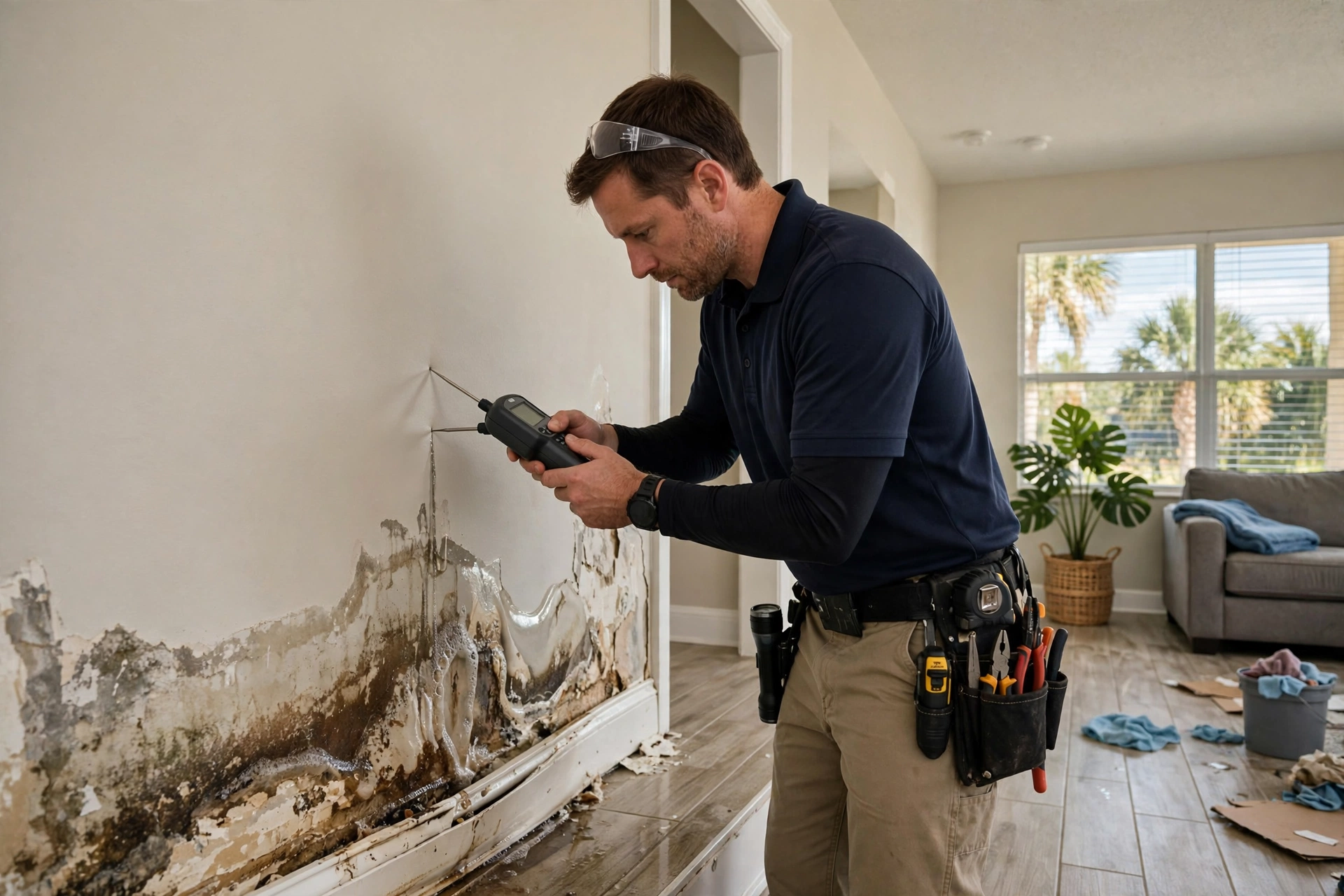
This is the single biggest quality separator. Professional crews map moisture with meters and thermal imaging, photograph everything, and keep daily drying logs. That file is your insurance evidence, your proof the home reached dry targets, and your protection if a dispute starts later. A company that "just knows" when a wall is dry is guessing with your claim money.
4. Do they work to IICRC S500 standards?
The IICRC S500 is the industry standard for water damage restoration: how water is categorized, how drying goals are set, when materials can be saved. Ask directly which standard they follow and check their certifications before the truck rolls. Standards are also what adjusters measure a scope against, so a standards-based company and your insurer are speaking the same language from day one.
5. Will they price repair work in a written quote?
Emergency mitigation is legitimately hard to price to the penny on the phone, but once the home is stable, every following phase should come with a written, line-item quote before work starts. Vague verbal totals protect the company, not you. Written quotes also let you compare two companies on identical scopes instead of competing slogans.
6. Do they understand Florida licensing and insurance law?
Florida rules trip up out-of-state storm chasers every season. Key facts a real Florida company should know cold: assignment of benefits (AOB) agreements are banned for policies issued or renewed after January 1, 2023, so no one should ask you to sign your claim away; hurricane claims must be reported within one year of the loss; supplemental claims get 18 months; and mold work over 10 square feet needs a licensed remediator. If the person on the phone cannot discuss these, they are not a Florida restoration company, they are a visitor.
7. What do their reviews actually say?
Read the pattern, not the star average. Look for specifics: response times, documentation, how billing surprises were handled, whether the same names get praised twice. A wall of identical five-star one-liners with no detail tells you little. Our reviews page is a fair example of the detail level to look for, dates, cities, job types.
8. Do they use pressure tactics?
The last check is behavioral. "Sign now or the price doubles," door-knocking after storms, refusing to itemize, or demanding you hand over the entire insurance check are all walk-away signals. A confident water damage restoration company explains the job, writes it down, and lets you decide, because its documentation survives your scrutiny. Learn more about how we work on our about page, and compare answers in our FAQ.
What should you ask on the first call?
Keep it short: How fast can a crew reach my address? Will you document moisture readings for my insurer? Do you follow IICRC S500? Will drying and repair be quoted in writing before each phase? Are you licensed and insured in Florida? Five questions, two minutes, and the answers will rank every company you call better than any advertisement can.
Should you use the company your insurer recommends?
Insurers often suggest a preferred vendor, and there are real advantages: the billing process is smoother and the paperwork format is familiar to the adjuster. But Florida law gives you the right to choose your own contractor, and that choice matters. A preferred vendor ultimately answers to the carrier's program; an independent company answers to you. Many homeowners use the insurer's suggestion for emergency mitigation speed, then compare written repair quotes before committing to the rebuild. Whichever route you take, the documentation standard is the same, and a good company will tell you plainly that the choice is yours.
Does one company handle the whole job, or hand you off?
Some firms only mitigate: they extract and dry, then leave you to find a builder for repairs. Others manage the full sequence through final paint. Neither model is automatically better, but you should know which one you are hiring before the first truck arrives, because the handoff point is where documentation gets lost and timelines stall. If the company hands off, insist on the complete moisture log and photo file before they leave; that file is what your repair contractor and your adjuster both work from. If they handle everything, one contract and one point of accountability usually means a faster, cleaner claim.
How many quotes should you get during an emergency?
For the emergency phase, speed beats shopping: get the water stopped and extracted by the first qualified company that can arrive, because every hour of delay raises the final bill more than any price difference between reputable firms. Save the comparison shopping for the repair phase, where two or three written quotes on identical scopes are worth real money and the home is no longer getting wetter while you decide. That split, mitigate now, compare for the rebuild, is how experienced Florida homeowners play it after twenty hurricane seasons of practice.
What is the bottom line?
The right company is the one whose answers you can verify: real arrival times, moisture readings you can see, standards you can look up, prices in writing, and Florida rules quoted correctly. Choose that company and the rest of the job, the drying, the claim, the rebuild, tends to take care of itself. Choose on a slogan, and you will spend the next month managing the consequences.
Judge us by the same checklist.
Live answer 24/7, documented drying to S500 targets, written quotes per phase, 293 Florida cities. Call and ask us the five questions.
Call 24/7: (607) 300-1334